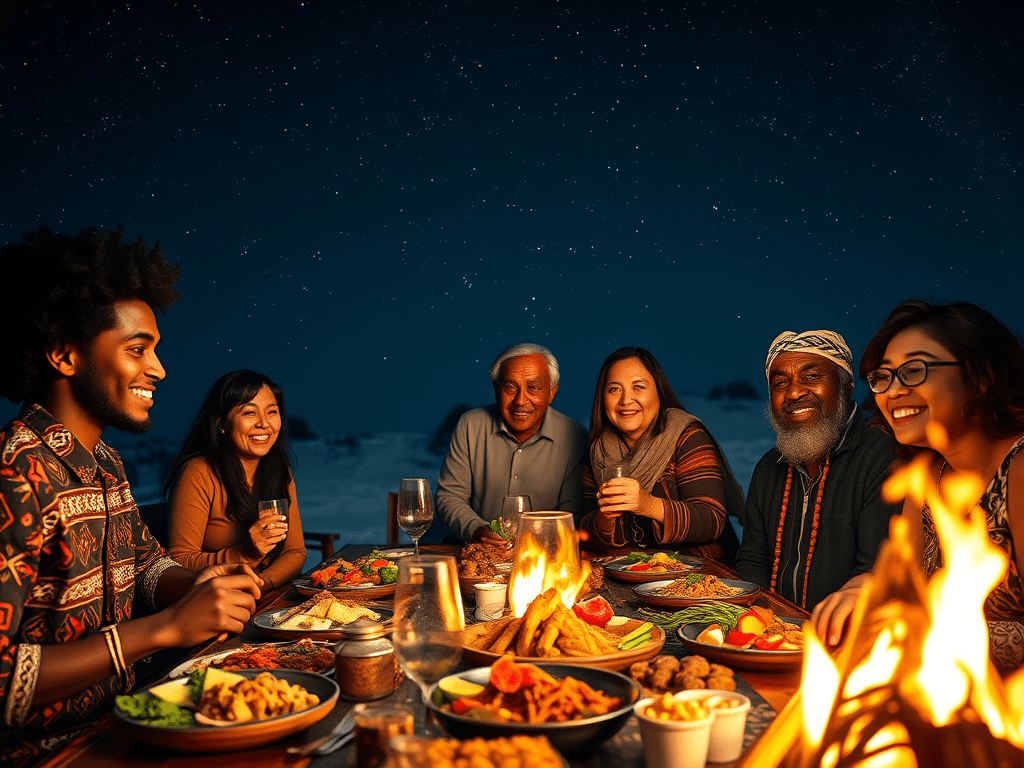
There’s something magical about gathering under a winter sky, sharing food, stories, and laughter with people who were once strangers but now feel like whānau (Family). This year, for the first time, I was invited by my Māori neighbors to celebrate Matariki – the Māori New Year – and what unfolded was a beautiful reminder of how culture, community, and connection can bridge even the widest gaps.
A New Kiwi’s First Matariki
When I moved to New Zealand, I knew there would be moments of cultural immersion that would stretch me beyond my comfort zone. But nothing could have prepared me for the warmth and depth of a traditional Matariki celebration. Growing up in Somalia and later living in different parts of the world, I’ve always been drawn to the ways communities mark time – through festivals, feasts, and shared rituals. Matariki, with its focus on remembrance, gratitude, and looking forward, felt both familiar and beautifully unique.
My neighbors (Lovely family) had mentioned weeks earlier that they’d love to have me join their gathering. “Bring a dish from your culture,” they said, “and we’ll fill the table with ours.” And so, on a crisp winter evening, I arrived with a pot of bariis kala karis (Somali spiced rice), nervous but excited to share a piece of home while stepping into theirs.
The Feast: A Tapestry of Flavors and Stories
The table was a vibrant mosaic of kai (food) – tender hāngī-cooked lamb and kūmara, rewena bread, creamy paua fritters, and a pot of boil-up that filled the air with rich, earthy aromas. Alongside these were dishes from other neighbors: samosas from an Indian family, Filipino pancit, and my Somali rice – each dish a story, each flavor a thread in the fabric of this shared moment.
As we ate, my hosts explained the significance of Matariki – the cluster of stars known as the Pleiades, whose rising marks the new year. It’s a time to honor those who have passed, celebrate the present, and set intentions for the year ahead. One of the elders shared how her ancestors used the stars to guide planting and harvesting, and how today, Matariki is a reclamation of Māori knowledge and identity.
I found myself nodding along, thinking of how back home, we too relied on the stars and seasons – how the lunar calendar dictated our fasting, feasting, and migrations. The universality of celestial connection hit me then: no matter where we’re from, humans have always looked up to make sense of our place in the world.
Stories Around the Fire
After the feast, we moved outside where a small fire crackled under a sky slowly revealing its stars. Someone brought out a guitar, and soon, the air was filled with songs – some in te reo Māori, some in English, and others in languages I didn’t recognize but whose melodies needed no translation.
Then came the stories. My hosts encouraged everyone to share something – a memory, a hope, or a reflection on the past year. When it was my turn, I spoke about my journey to Aotearoa, the loneliness of being far from family, and the unexpected kindness of neighbors who had become friends. I talked about how, in Somalia, we have a saying: “Aqoon la’aan waa iftiin la’aan” (Without knowledge, there is no light). Tonight, I felt like I was gathering new light – new understanding – through this tradition that was not mine, yet now somehow part of me.
Embracing Diversity While Honoring Roots
As the night wound down, I sat back, watching the faces illuminated by firelight – Māori, Pākehā, Pasifika, African, Asian – all laughing, singing, and passing around cups of kawakawa tea. It struck me that this was Aotearoa at its best: a place where cultures don’t just coexist but enrich one another.
Celebrating Matariki with my neighbors didn’t mean I had to shed my own identity. Instead, it was an invitation to add another layer to it – to learn, respect, and find common ground under the same sky.
A New Tradition Begins
Walking home that night, the stars seemed brighter, as if Matariki itself was winking down at me. I thought about how traditions begin – not just in ancient times, but now, in backyards and community halls, through shared meals and stories. This was my first Matariki, but it won’t be my last.
To my Māori neighbors, thank you for your generosity, for teaching without hesitation, and for reminding me that home isn’t just a place – it’s the people who make space for you at their table.
And to you, dear reader, whether you’re a fellow new Kiwi, a longtime local, or someone oceans away – may you find light in new traditions, and may your own stories always have a place to be heard.
Haere mai, Matariki. Welcome, new year.





 Abdinz
Leave a comment